When is the sun blocked by the mountains?
January 5, 2026
I'm visiting my parents this winter in the French Alps. I missed the mountains I grew up with, but I had forgotten how much sun they hide at this period of the year. I thought I'd use the cold and shady time to compute when it's going to be sunny at my parent's house, so that I can plan ahead for the optimal reading time (isn't it nicer to read in the sun?)
This computation involves the following steps:
- Compute the horizon from the reading spot. This can be done with ray casting on an elevation map.
- Compute the trajectory of the sun in the sky, given the time of the year.
It is sunny when the sun is above the horizon. The horizon is defined by the silhouette formed by mountains around me.
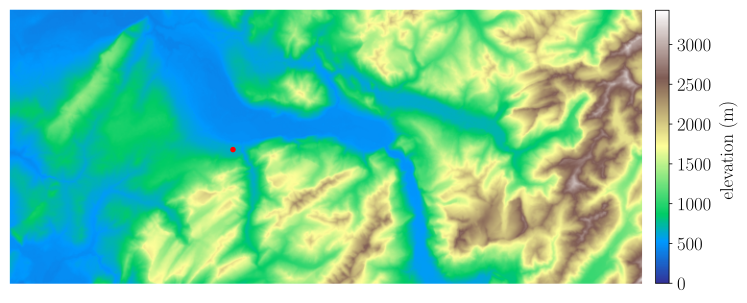
I went ahead and downloaded the topographic map of the area from Copernicus GLO-30 Digital Elevation Model1. I have selected a region large enough to cover most visible mountains from here.
Then, I computed the horizon from this map. This is computed as the maximum of along a ray starting at my location. In the above equation, is the elevation at the view point, is that along the ray, and is the distance from the view point. I have repeated this for any azimuth angle (this angle is 0 when pointing north, and 90 degrees when pointing east):
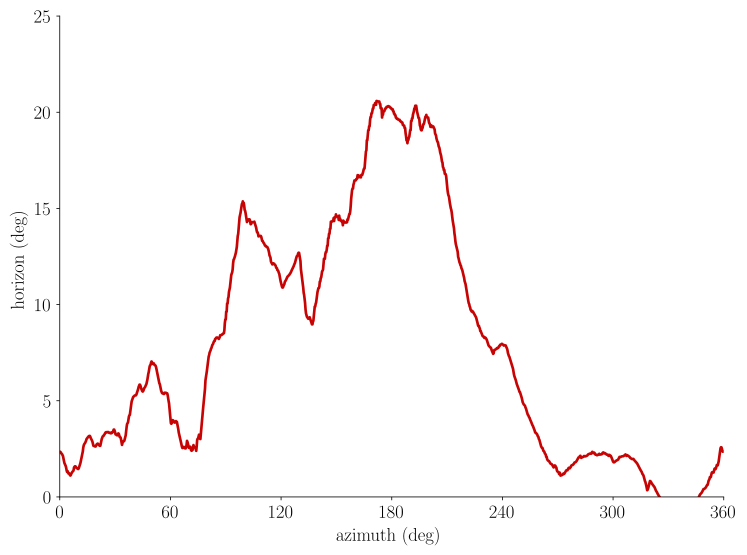
I didn't look for horizon data to double check these results but I easily recognize many mountains, I've seen them so many times. There's the Mole at around 55 degrees, pointe d'Andey at around 110 degrees and the pointe de Cou in the South direction. This latter peak is the main culprit for hiding the sun during winter.
The trajectory of the sun depends on the time of the year. I have used the following code to estimate its trajectory. This is a blind copy-paste from ChatGPT.
Show code
def day_of_year(d: datetime.date) -> int:
    return d.timetuple().tm_yday

def refraction_correction_deg(elevation_deg):
    """
    Atmospheric refraction correction in degrees.
    Valid for elevations > ~ -1 deg.
    """
    h = elevation_deg
    if h < -1:
        return 0.0
    return (1.02 / np.tan(np.deg2rad(h + 10.3 / (h + 5.11)))) / 60.0

def solar_position_noaa(lat_deg, lon_deg, when_local, tz_offset_hours):
    """
    Approx solar azimuth/elevation (degrees) using NOAA-style formulas.
    lat_deg, lon_deg: observer location (deg), lon positive east.
    when_local: naive datetime in LOCAL time (no tzinfo)
    tz_offset_hours: e.g. +1 for CET, +2 for CEST
    Returns: (azimuth_deg, elevation_deg)
      azimuth: degrees clockwise from North (0=N, 90=E)
      elevation: degrees above horizon
    """
    # --- constants / conversions
    deg2rad = np.deg2rad
    rad2deg = np.rad2deg

    lat = deg2rad(lat_deg)

    # Day of year
    n = day_of_year(when_local.date())

    # Fractional year (gamma) in radians
    # hour in local time
    hour = when_local.hour + when_local.minute/60 + when_local.second/3600
    gamma = 2.0*np.pi/365.0 * (n - 1 + (hour - 12)/24.0)

    # Equation of time (minutes)
    eqtime = 229.18 * (
        0.000075
        + 0.001868*np.cos(gamma)
        - 0.032077*np.sin(gamma)
        - 0.014615*np.cos(2*gamma)
        - 0.040849*np.sin(2*gamma)
    )

    # Solar declination (radians)
    decl = (
        0.006918
        - 0.399912*np.cos(gamma)
        + 0.070257*np.sin(gamma)
        - 0.006758*np.cos(2*gamma)
        + 0.000907*np.sin(2*gamma)
        - 0.002697*np.cos(3*gamma)
        + 0.00148*np.sin(3*gamma)
    )

    # Time offset (minutes)
    # lon_deg positive east; tz_offset_hours hours east of UTC
    time_offset = eqtime + 4.0*lon_deg - 60.0*tz_offset_hours

    # True solar time (minutes)
    tst = (hour*60.0 + time_offset) % 1440.0

    # Hour angle (degrees)
    ha_deg = tst/4.0 - 180.0
    ha = deg2rad(ha_deg)

    # Solar zenith angle
    cos_zenith = np.sin(lat)*np.sin(decl) + np.cos(lat)*np.cos(decl)*np.cos(ha)
    cos_zenith = np.clip(cos_zenith, -1.0, 1.0)
    zenith = np.arccos(cos_zenith)

    elevation = 90.0 - rad2deg(zenith)

    # Solar azimuth (NOAA convention)
    # Compute azimuth from north, clockwise
    sin_az = -np.sin(ha) * np.cos(decl) / np.sin(zenith)
    cos_az = (np.sin(decl) - np.sin(lat)*np.cos(zenith)) / (np.cos(lat)*np.sin(zenith))
    az = np.arctan2(sin_az, cos_az)  # radians, range [-pi, pi]
    az_deg = (rad2deg(az) + 360.0) % 360.0

    return az_deg, elevation

def solar_track(lat, lon, date, tz_offset_hours, start_h=6, end_h=22, step_min=1):
    times = []
    azs = []
    els = []
    t = datetime.datetime(date.year, date.month, date.day, start_h, 0, 0)
    t_end = datetime.datetime(date.year, date.month, date.day, end_h, 0, 0)
    step = datetime.timedelta(minutes=step_min)
    while t <= t_end:
        az, el = solar_position_noaa(lat, lon, t, tz_offset_hours)
        times.append(t)
        azs.append(az)
        els.append(el)
        t += step

    els = np.array([
        el + refraction_correction_deg(el)
        for el in els
    ])
    return np.array(times), np.array(azs), np.array(els)
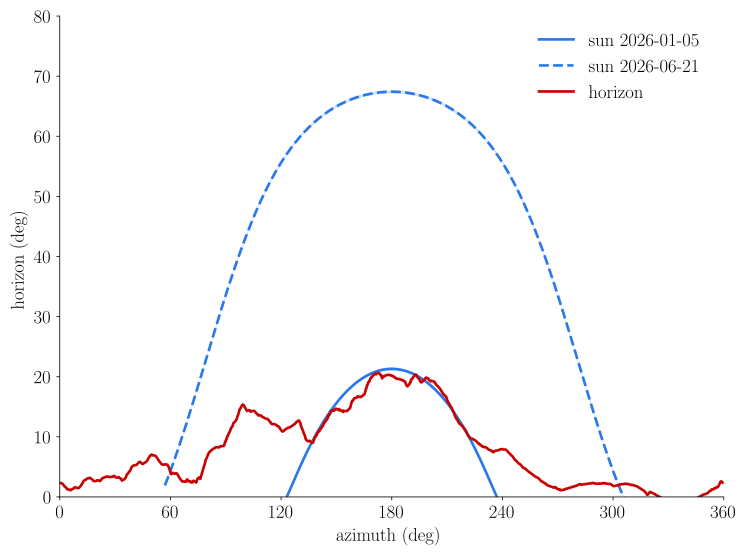
In summer, the sun is high up in the sky, and the mountains don't block the light. In winter, like today, the sun is very close and often below the horizon:
The following figure shows when the sun will be above the horizon today, based on the model above:
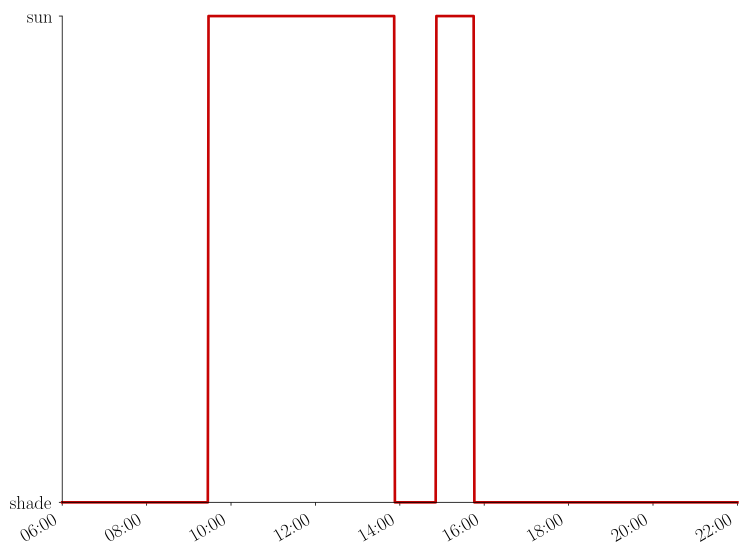
There are many approximations here: I ignored trees, buildings, clouds, and could use a better model for the sun trajectory. Yet the results seem consistent with what I saw yesterday. Today, I'll be able to read in the sun from 9:27 to 13:52, and then from 14:51 to 15:45. Now I just hope that no cloud will disturb my plans!
-
European Space Agency (2024). Copernicus Global Digital Elevation Model. Distributed by OpenTopography. https://doi.org/10.5069/G9028PQB. Accessed 2026-01-04. ↩